Ledger in plain SQL
The state tables and locked transition functions live in reviewable migrations; the ledger is the sole transition writer.
Irrevon is an open-source reference engine and benchmark — local-first, no hosted service, no accounts. The engine is the “proposed system” baseline inside the benchmark, not a product: it registers intent, persists before dispatch, gates deterministically, and reconciles ambiguity by querying the destination.
Evidence: Design specificationTechnical provenance
Evidence: Design specificationTechnical provenance
The engine core is implemented and tested: identity derivation, the append-oriented ledger with locked transition functions in plain SQL, the commit gate, dispatch and receipts, reconciliation with confirmed-absence, crash recovery, and the orphan sweep — plus reference destinations, the CLI, and the read-only workbench.
The state tables and locked transition functions live in reviewable migrations; the ledger is the sole transition writer.
The mechanics — claim protocol, commit gate, confirmed-absence protocol, recovery order — are specified in RFC-002 and implemented from it.
Intent contracts, effect records, receipts, findings, and capability declarations are JSON-schema pinned, with valid and invalid example suites enforced in CI.
Evidence: Verified evidenceTechnical provenance
Every adapter ships a version-pinned, cited declaration of what its destination actually guarantees: the tier, the idempotency semantics, what is queryable, and the consistency bounds. Contract drift forces a declaration update, a retest, and a deviation record before any benchmark use.
{
  "adapter": "refdest-c2",
  "destination": "Irrevon reference destination (C2 profile)",
  "api_version": "refdest-1",
  "tier": "C2",
  "idempotency": { "supported": false },
  "queryable": {
    "supported": true,
    "by": ["destination_ref", "client_ref"]
  },
  "client_ref_field": "client_ref",
  "list_queryable": true,
  "consistency": {
    "status_settlement_lag": "PT0S",
    "listing_lag": "PT0S"
  },
  "compensation_hook": null,
  "citations": ["https://irrevon.dev/refdest/contract#c2"],
  "evidence_quality": "VF"
}
This is the loaded declaration for the reference C2 destination the recorded demo runs against — verbatim from the repository’s example suite. "idempotency": { "supported": false }plus "queryable": true is exactly the C2 shape: the destination won’t honor your key, but it will answer for what exists.
Where a destination’s docs list parameters but never state “no idempotency,” the C2 classification is an evidence-backed inference and the declaration says so (evidence_quality).
Evidence: Design specificationTechnical provenance
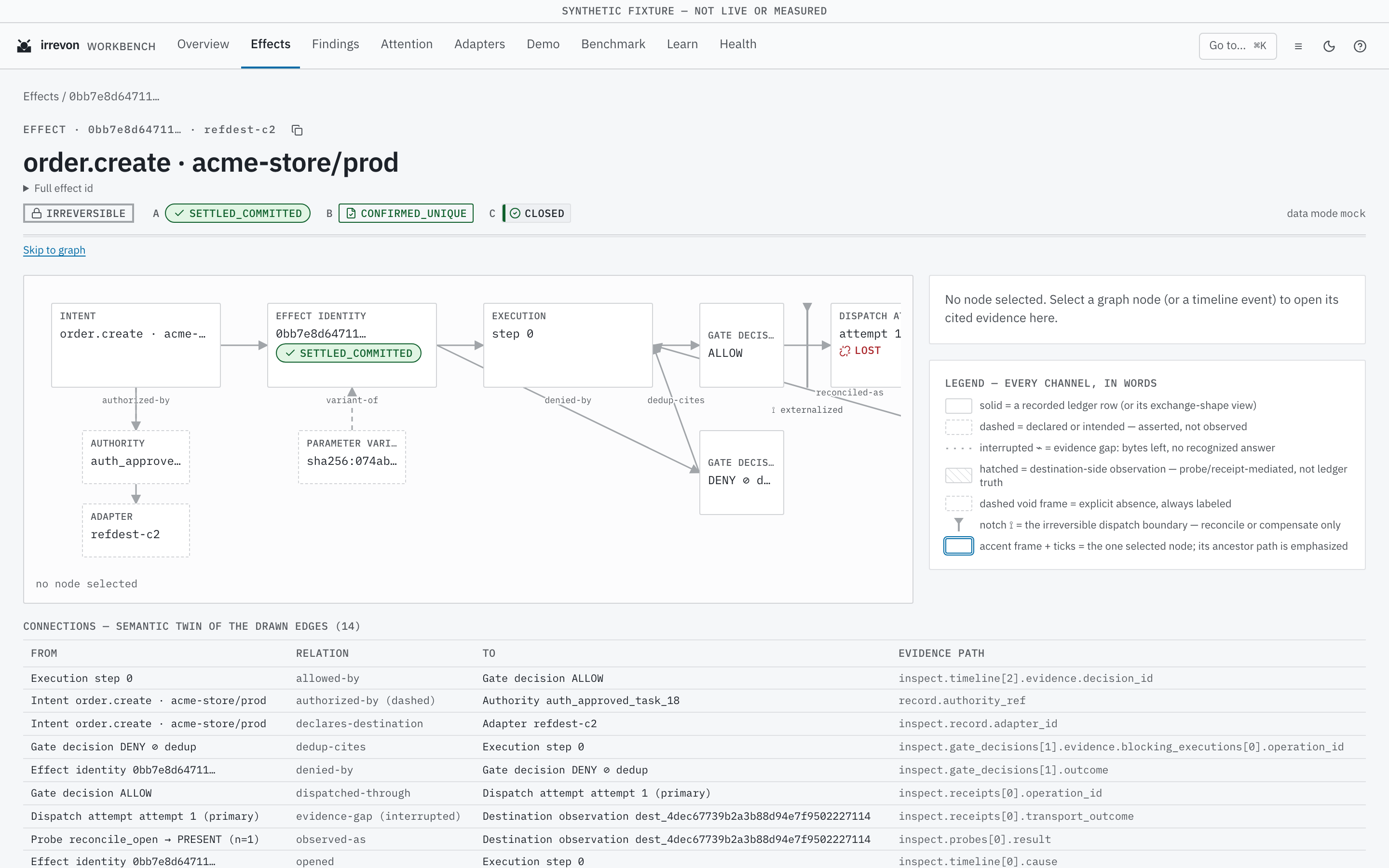
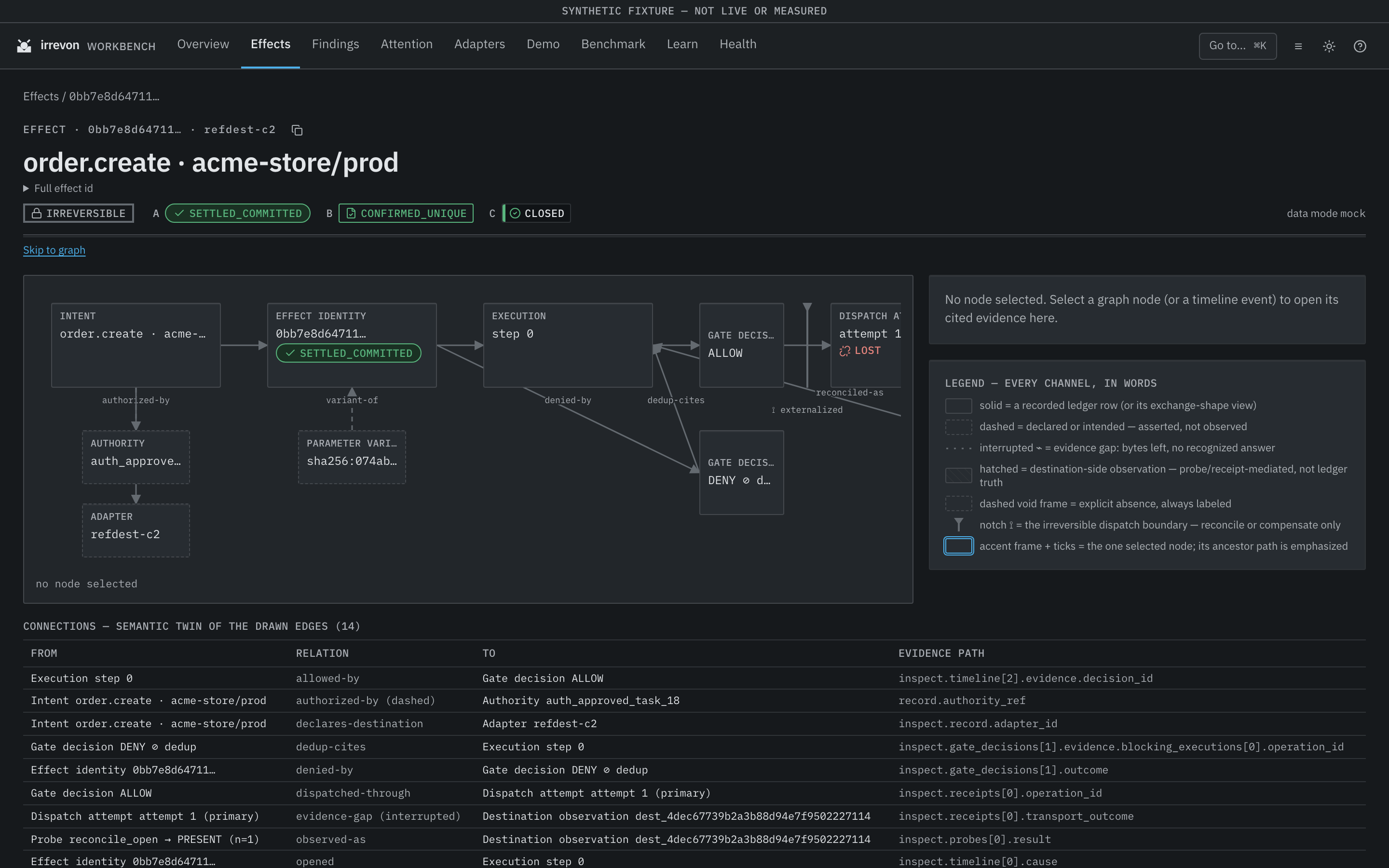
Evidence: Verified evidenceTechnical provenance
Scroll table horizontally
| Stage | Contents | Status |
|---|---|---|
| Engine core | Identity, ledger, gate, dispatcher, reconciliation, recovery, sweep, reference destinations, CLI, workbench | Implemented |
| Provider adapters | Real sandbox adapters (C1 Stripe test mode; one C2 sandbox) with cited capability declarations | Gated — sandbox selection and API-version pins require human review |
| Benchmark harness | Seeded workloads, fault schedules, oracle, the full baseline ladder | Developmental S-REF pilots only; live and confirmatory runs remain freeze-gated |
| Release | Published `v0.1.0` software package; research preprint | Software published; scientific publication and provider qualification remain gated |
Evidence: Verified evidenceTechnical provenance